
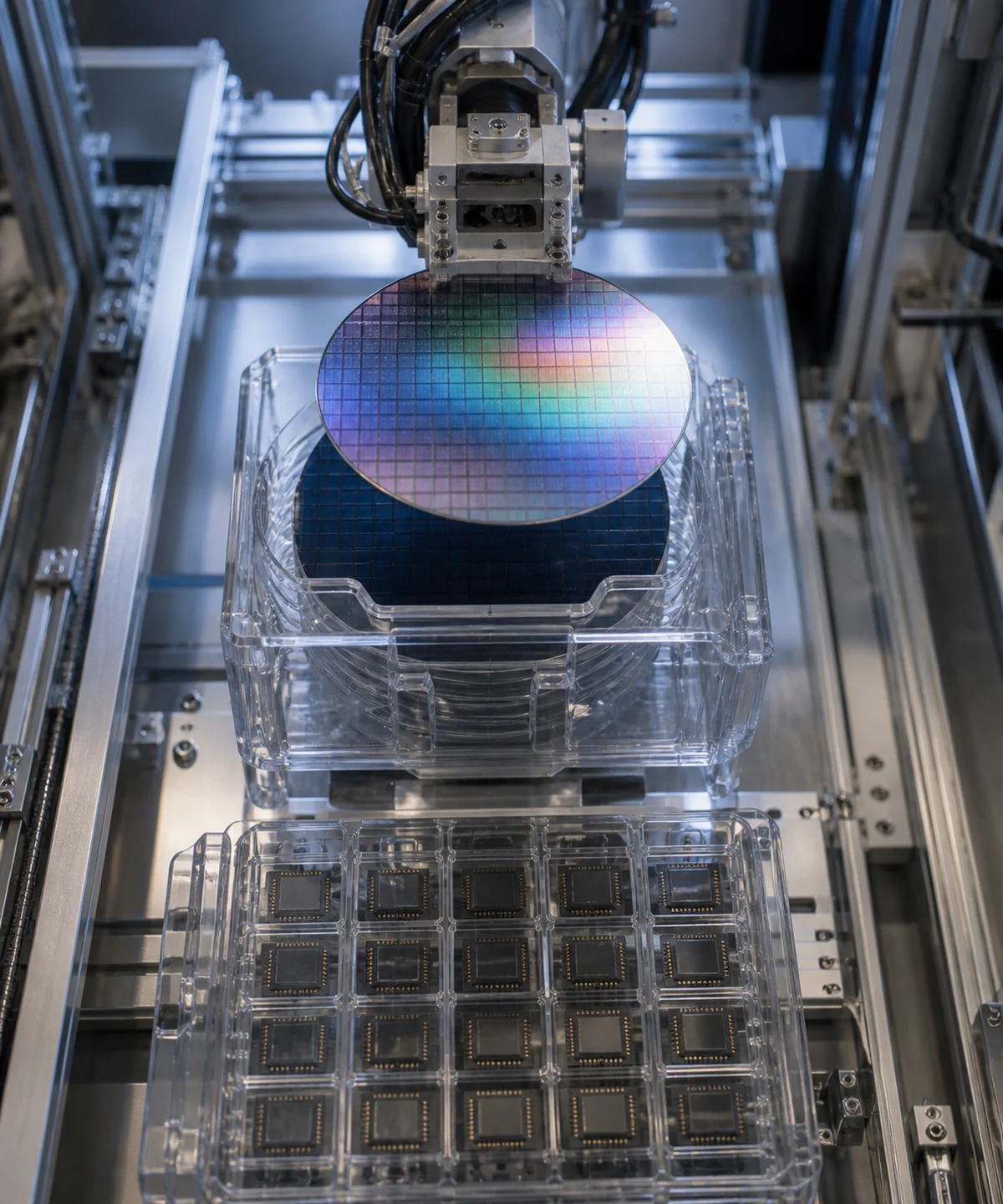
In semiconductor packaging and testing, a chip must go through dozens of transfers from wafer dicing to completed packaging. In every operation, the chip depends on trays or carrier boxes for precise positioning and electrostatic protection.
For a long time, the mainstream material for IC trays has been modified polyphenylene ether (MPPO). With dimensional stability, heat resistance and low warpage, it has long been used for IC trays. But as semiconductor production lines become more automated and cleanliness requirements become stricter, a previously underappreciated requirement is emerging: trays and carrier boxes need to be transparent.
Automated optical inspection systems need to see through packaging to identify chip direction and model. Operators need to confirm material status without opening covers. Cleanrooms need to reduce cover-opening operations to lower contamination risk. Traditional MPPO becomes black and opaque once carbon black or carbon fiber is added to provide conductivity. This conflict between seeing clearly and protecting effectively has created demand for transparent antistatic materials.
1. Why traditional PPO trays cannot be seen through
PPO (polyphenylene ether) became the mainstream base material for IC trays because of its combined advantages in dimensional stability, heat resistance (120-150°C baking), low warpage and static dissipation capability.
The problem is that PPO itself is not conductive. To give the tray antistatic function and prevent static from damaging chips, conductive fillers such as carbon black or carbon fiber must be added to PPO. Once these fillers are added, the material becomes black or dark and opaque. MPPO trays therefore appear black, operators cannot see the chips inside through the tray, and automated vision systems cannot inspect through it.
For scenarios that require visual inspection or optical recognition, traditional MPPO trays have a natural limitation.
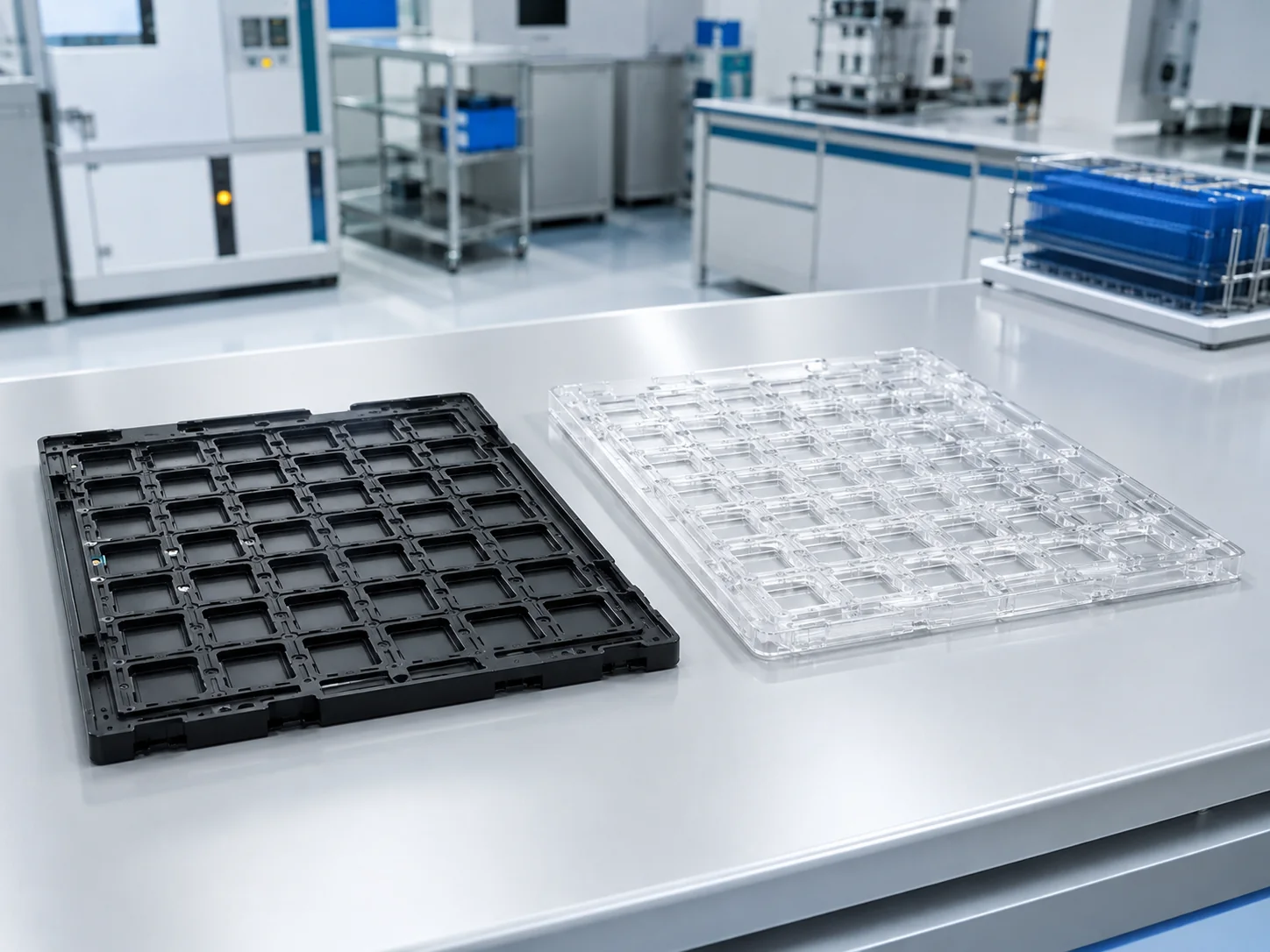
2. Transparent antistatic ABS: a new technical route
In the past, transparency and antistatic performance were difficult to achieve at the same time because antistatic performance mainly relied on carbon black filling, and carbon black itself is black. The breakthrough comes from polymeric permanent antistatic agent technology.
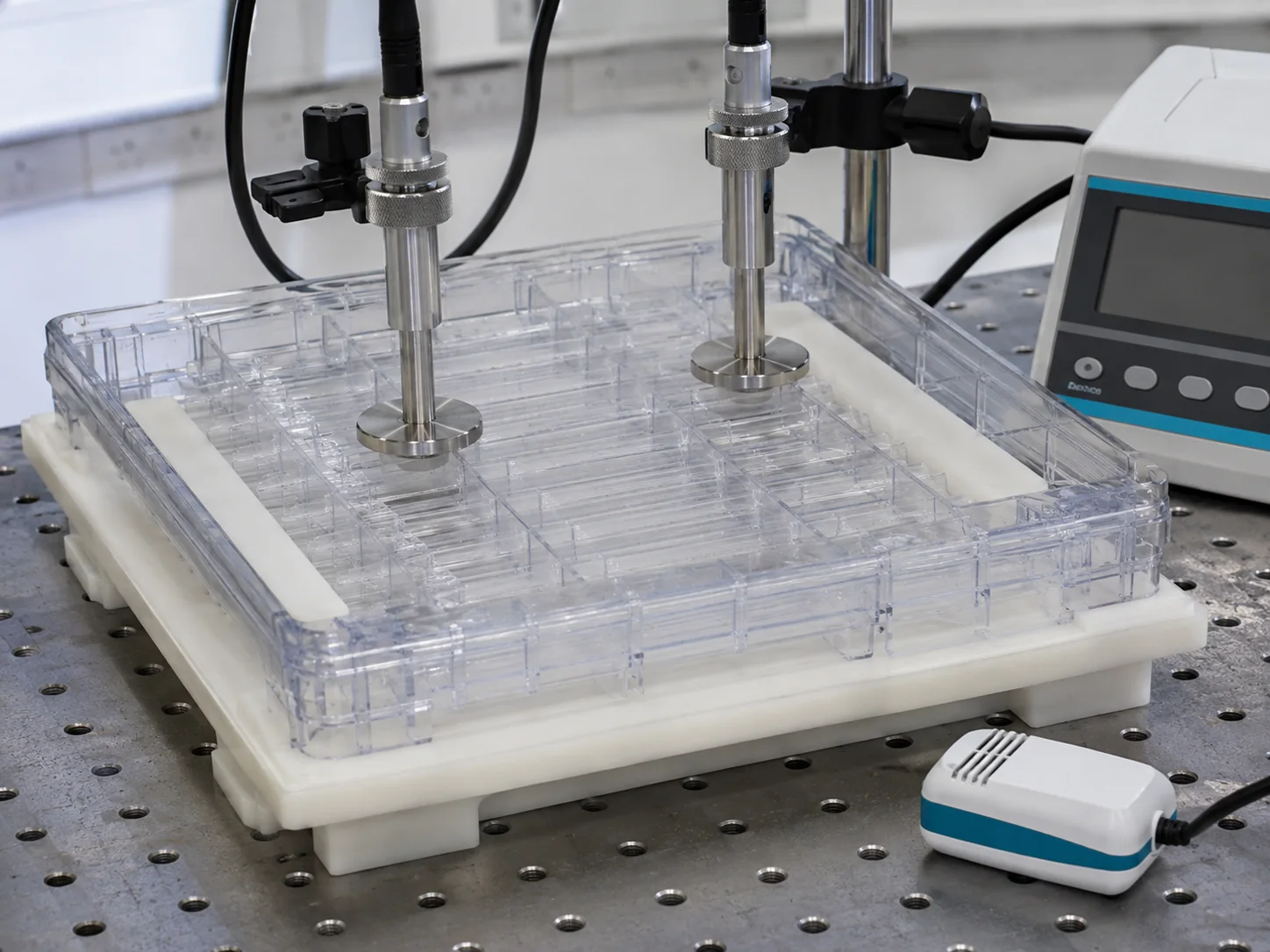
Clearastatic DGK-ABS KJD890TM uses this technical route: polymeric permanent antistatic agent is melt-blended with a transparent ABS base material, forming a sub-microscopic conductive network inside the substrate. It provides a stable electrostatic dissipation path while keeping visible-light scattering at a low level.
Unlike low-molecular antistatic agents that rely on environmental humidity and migrate to the surface, this solution anchors the antistatic component in the substrate in polymer form. It does not migrate or bloom, and after repeated water washing or long-term storage, surface resistivity does not change significantly.
Core performance indicators:
- Light transmission: about 85% (2 mm thickness)
- Surface resistivity: 10⁸-10¹⁰ Ω/□ (site material-table range)
- Heat deflection temperature: 85°C (0.45 MPa)
- Melt flow rate: 48 g/10min (220°C/10 kg), strong flowability suitable for thin-wall and complex injection-molded structures
- Izod notched impact strength: 12.3 kJ/m²
In the transparent antistatic ABS category, 85% light transmission is a relatively high level. A melt flow rate of 48 g/10min supports smooth filling and can shorten the injection-molding cycle.
3. Where transparency matters: wafer carrier boxes and IC trays
DGK-ABS KJD890TM covers multiple stages of semiconductor and electronics manufacturing:
Wafer carrier boxes: during transfer from wafer dicing to packaging, carrier boxes need to be transparent so operators can visually inspect wafer status while preventing static from attracting fine dust that contaminates chips.
IC trays: in packaging and testing, IC trays carry chips in package formats such as BGA and QFN. Transparency helps vision systems identify chip direction and model.
Semiconductor packaging carrier tape: carrier tape needs transparency so optical inspection systems can identify component position, while antistatic performance prevents components from shifting because of static during high-speed conveying.
Cleanroom equipment housings and observation windows: cleanroom equipment needs transparent windows for internal status observation, while antistatic performance prevents dust adhesion from affecting equipment precision.

4. Engineering validation in production
DGK-ABS KJD890TM has already been validated on actual production lines.
In the batch application of medical monitor panels, the customer originally used ordinary transparent ABS with a sprayed antistatic surface agent. Surface resistance was qualified at shipment, but in ICU environments the panel was wiped daily with 75% alcohol. After 3-6 months, the antistatic coating was consumed, and the screen attracted dust because of static, affecting readings.
After switching to DGK-ABS KJD890TM, surface resistivity changed by less than one order of magnitude after 500 alcohol wipes and 15% low-humidity environment testing, remaining within the 10⁸-10⁹ Ω/□ range. Delivery and after-sales information comes from Clearastatic project records; the customer name is withheld for confidentiality.
In the semiconductor field, the same material is suitable for wafer carrier boxes, IC trays, cleanroom observation windows and similar scenarios. Operators can confirm internal material status without opening the package, and vision systems can identify directly through the packaging.
5. Selection boundary: where the two materials fit
Transparent antistatic ABS will not completely replace PPO. The application boundary depends on the specific working conditions:
| Comparison Dimension | MPPO Tray | Transparent Antistatic ABS Tray |
|---|---|---|
| Light transmission | Opaque (black/dark) | Transparent (≥85%) |
| Surface resistivity | 10⁶-10⁹ Ω/□ (project range) | 10⁸-10¹⁰ Ω/□ |
| Heat deflection temperature | 125-140°C | 85°C |
| Core applications | High-temperature baking IC trays, wafer carriers | Wafer carrier boxes, cleanroom windows, IC trays requiring visual inspection |
PPO remains irreplaceable in scenarios that need to withstand baking above 125°C and require extreme dimensional stability. But in wafer carrier boxes, cleanroom observation windows, IC trays requiring visual inspection and automated optical recognition, transparent antistatic ABS is becoming a new option.
6. Enterprise capability and supply assurance
Clearastatic has years of R&D accumulation in conductive and antistatic plastics. DGK-ABS KJD890TM uses brand-new transparent ABS base material blended with polymeric long-term antistatic additives. No recycled material is added, and every batch is supplied with national-standard physical property test reports.
For supply assurance, Clearastatic provides small-batch validation service starting from 5 kg, with sample delivery in 72 hours. The company has 8 production lines, monthly capacity of 800 tons, and batch resistivity Cpk ≥ 1.33. The technical team can provide injection-molding process window cards and mold design recommendations to help customers find a stable process window on existing equipment.