
Introduction
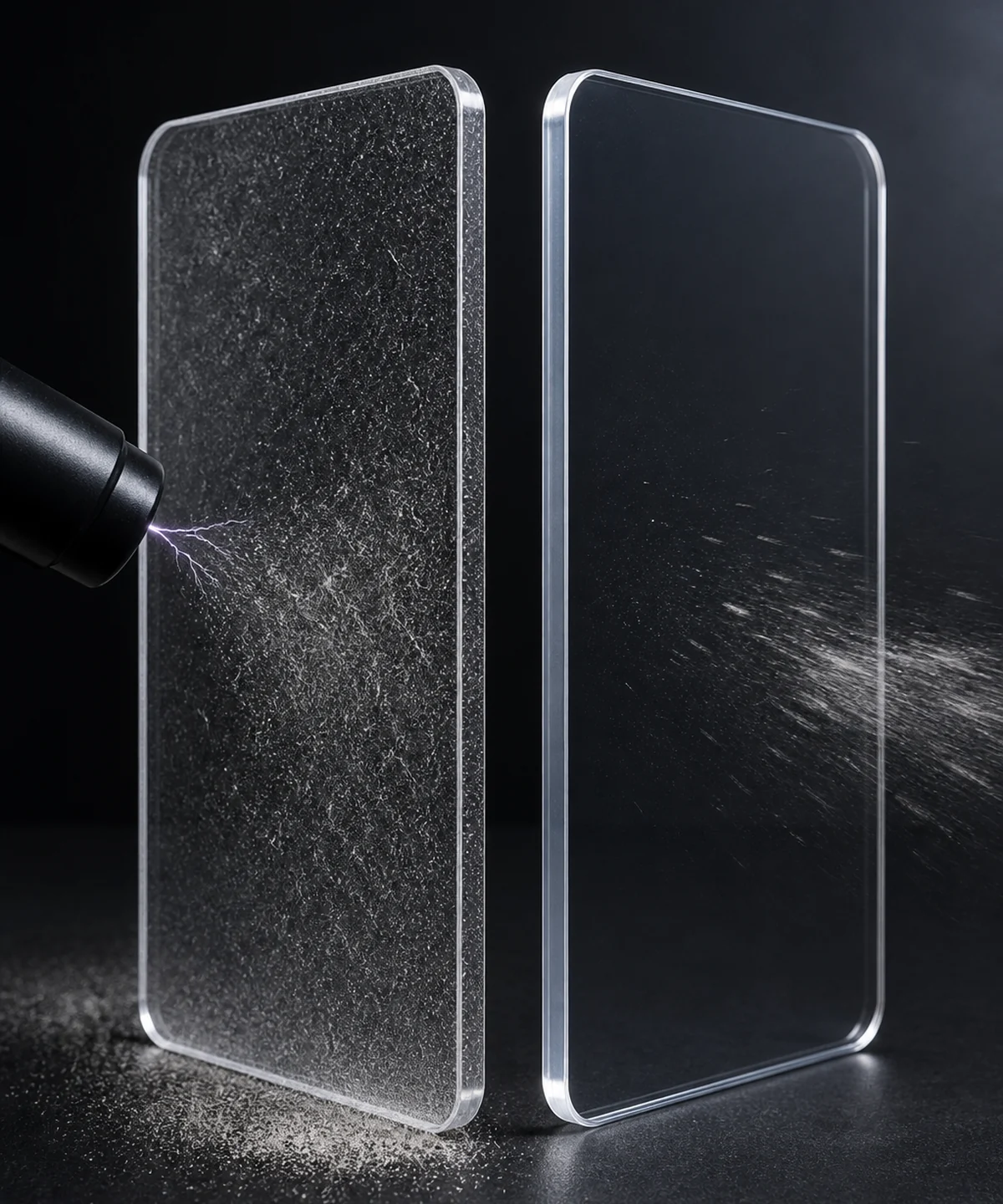
Transparent antistatic plastic is a functional polymer material that maintains high light transmission while suppressing long-term surface static accumulation. Represented by the Clearastatic DGK-KJD890TM series, it uses intrinsic modification for durable antistatic performance. Its surface resistivity is typically controlled within 10⁸-10¹¹ Ω/□ while retaining transparency for electronics, medical, packaging and related applications.
1. Everyday moments when static takes over
You have probably experienced this: when taking off a sweater in winter, small blue sparks appear in the dark with a crackling sound; when you touch a metal door handle, your fingertip suddenly hurts; when you shake hands with a friend, both of you pull back at the same time; even when combing hair, strands stand up as if by magic, becoming messier the more you comb.
The culprit behind these awkward moments is the same: static electricity.
Static is not exclusive to winter. In summer, humid air makes it easier for charge to be conducted away by moisture, so we do not feel it as strongly. In dry autumn and winter, there are fewer water molecules in the air, and the charge generated by friction has nowhere to go. It accumulates on surfaces until it finds an outlet and releases instantly, creating the shock and spark.
For ordinary people, static is usually just surprising or slightly painful. In many industries, however, static is a real source of damage. It can instantly scrap precision chips, create explosion hazards in dusty workshops, make medical instruments read inaccurately, and keep phone screens and computer monitors from ever looking clean. Transparent antistatic plastic entered our lives to solve these problems.
2. Why ordinary plastic builds up static so easily
To understand what makes transparent antistatic plastic effective, we first need to know why ordinary plastic is so prone to static.
The materials around us can roughly be divided into conductors and insulators. Metals are typical conductors. Charge can move freely inside them, so it is difficult for charge to build up. Plastics, rubber and glass are insulating materials. Once charge reaches the surface, it is like entering a dead end: it cannot escape or spread, so it stays in place and accumulates.
More importantly, plastic is everywhere in daily life: phone housings, computer screens, packaging bags, tableware, furniture and many other products. When these plastic products rub against other objects, such as a cloth wiping a screen, a hand touching a plastic shell, or plastic bags bumping against each other during transportation, electrons transfer between the contact surfaces, causing the plastic surface to become charged.
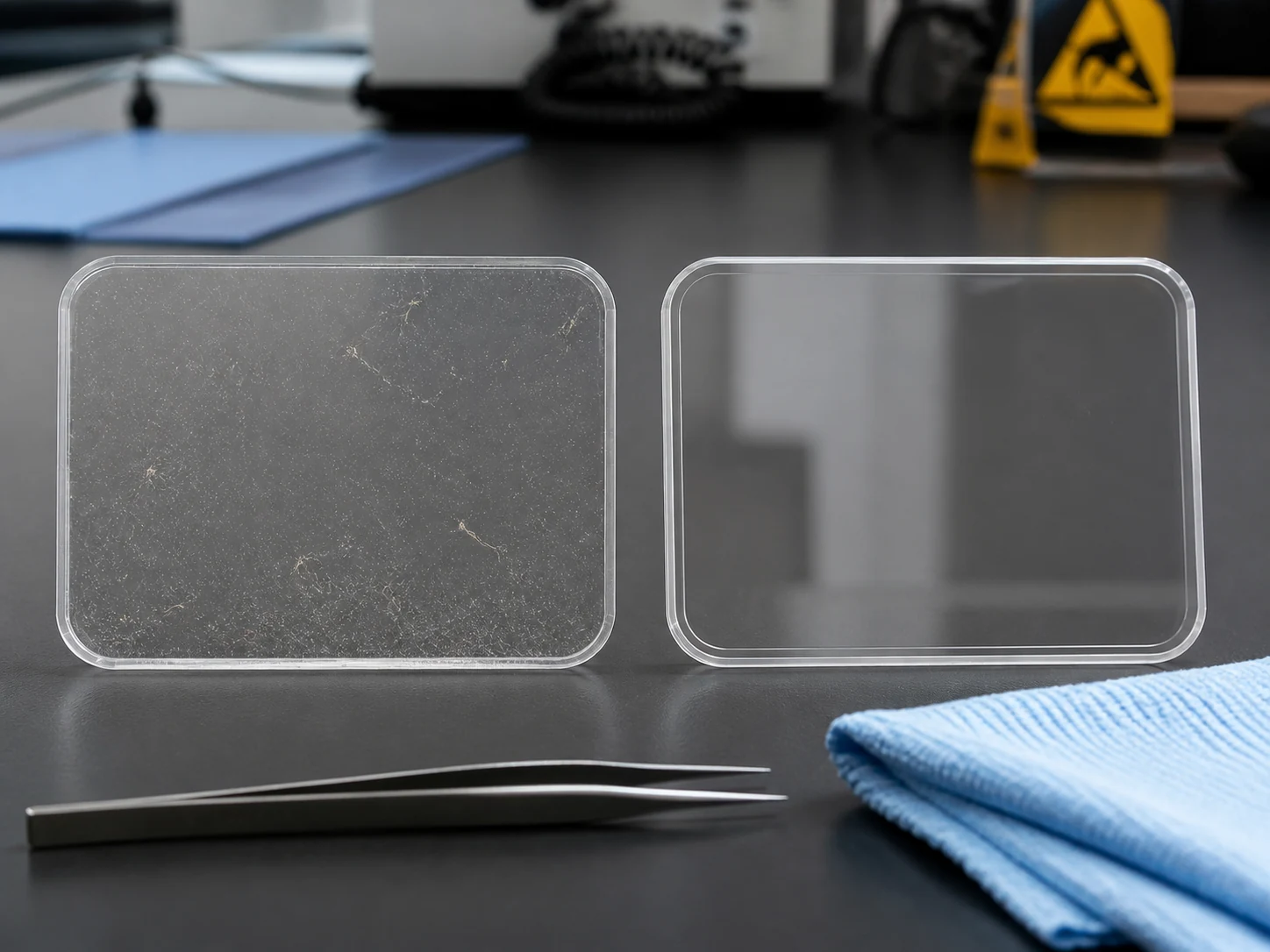
Charged plastic becomes a magnet for dust, hair and fibers in the air. The more you wipe it, the stronger the friction; the stronger the friction, the more static is generated, and the more firmly dust sticks. That is why phone screens and TV screens often look gray and cannot be wiped clean. In industrial settings, this adhesion effect is even more troublesome: dust entering precision instruments may cause failure, dust entering pharmaceutical packaging may affect safety, and dust falling on chips may directly cause scrap.
3. How transparent antistatic plastic controls static
If plastic itself is an insulator, how can it keep its clarity while guiding static away? There are currently two main approaches.
The first is the surface coating method. It is like giving plastic an invisible conductive coat by applying an extremely thin antistatic layer to the surface. This layer is only microns thick and does not affect light transmission, but it contains special conductive ingredients that form a fine electrical network on the plastic surface. Once accumulated charge touches this network, it spreads evenly and dissipates gradually instead of piling up locally. This method is simple and relatively low cost, but the disadvantage is that the coating gradually wears during use and cleaning, so the antistatic effect slowly decays.
The second is intrinsic modification, also called permanent antistatic modification. Simply put, the antistatic agent is mixed directly into the plastic raw material before molding, becoming integrated with the resin itself. The finished plastic part has antistatic ability from the inside out, so it is not afraid of surface abrasion or cleaning and the effect lasts longer. Clearastatic's DGK-KJD890TM series follows this route. Whether in the ABS version or PMMA version, the material property is marked as permanent antistatic, which means the antistatic ability is an inherent material property, not a disappearing outer layer.
Whichever route is used, the goal is to keep the electrical result within the project requirement. Surface resistance (Ω) and surface resistivity (Ω/□) are different quantities and should only be compared when the test method, electrode, specimen state and environment are consistent. Using the site material-table convention, the DGK-KJD890TM ABS grade has surface resistivity of 10⁸-10¹⁰ Ω/□ and the PMMA grade 10⁹-10¹¹ Ω/□; the actual molded part must still be validated.
At the same time, both materials have passed the UL-94 HB flame-retardancy test, supporting use safety while providing antistatic performance.
4. A clear ESD barrier in electronics factories
Walk into a phone or computer assembly workshop and you will notice an interesting scene: workers wear special antistatic garments, wrist straps are on their wrists, and even the floor beneath them is conductive. The whole workshop looks like it is carrying out an antistatic campaign.
This is not excessive. Circuits inside modern chips are measured at the nanometer scale, and thousands of circuits can fit across the diameter of a human hair. Such precision structures are extremely sensitive to static. A seemingly tiny electrostatic discharge can generate an instant voltage of thousands or even tens of thousands of volts, enough to puncture precision circuits inside a chip and cause permanent damage. More troublesome still, some damage does not show immediately. It lets the chip work while already injured, then fail suddenly after a period of use, which is fatal to electronic product reliability.
In this environment, transparent antistatic plastic plays an indispensable invisible-protector role.
Equipment guards and observation windows: production equipment needs clear windows so workers can monitor internal operation, but ordinary plastic windows easily accumulate static, attracting dust that blocks observation and potentially threatening nearby chips. With transparent antistatic plastic, these problems are solved.
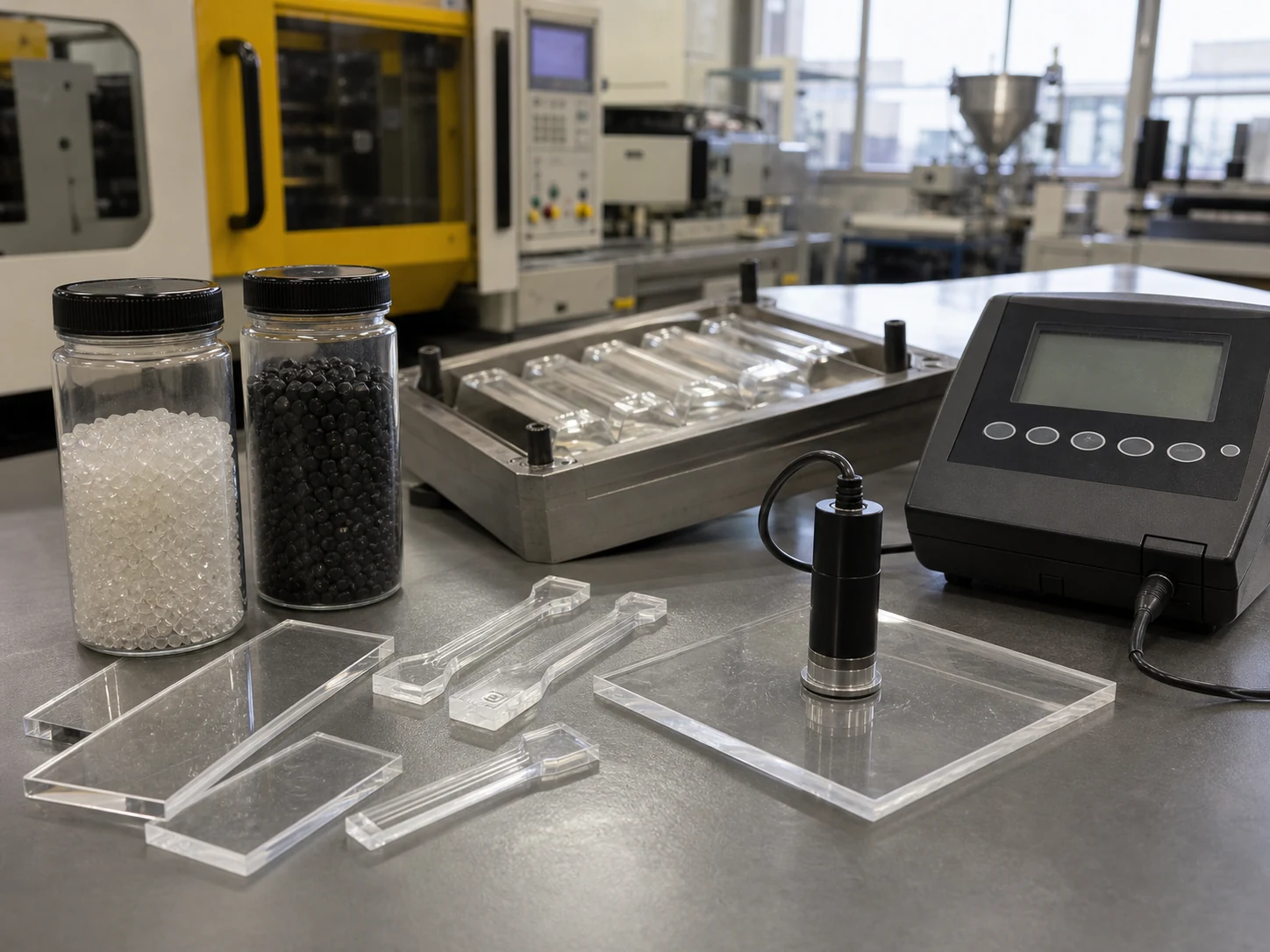
Component trays and handling boxes: chips and circuit boards need to be placed in trays during transportation and storage. If these trays are made from ordinary plastic, static generated by friction may directly damage the chips. Antistatic plastic trays can effectively dissipate charge and protect precision components.
Protective layers for display screens and touch panels: phone and computer screens need a protective film during production and transport. Antistatic protective films prevent scratching while avoiding static dust attraction, helping screens leave the factory clean.
In these scenarios, the ABS version of DGK-KJD890TM is especially popular. Its Charpy unnotched impact strength reaches 86 KJ/m², and its Izod notched impact strength is 12.3 KJ/m². It has excellent toughness and is not easy to crack or break, making it suitable for handling boxes, trays, equipment housings and other impact-resistant parts. Its melt flow rate is as high as 48 g/10min (220℃/10Kg), so it flows well, fills complex injection molds easily, has a broad processing window and supports a high yield rate.
Without transparent antistatic plastic, the production cost of electronics would rise significantly, the yield rate would fall noticeably, and the phones and computers in our hands might cost much more.
5. Medical, food, automotive and more
The capabilities of transparent antistatic plastic extend far beyond the electronics industry. It quietly plays a role in many fields people may not expect.
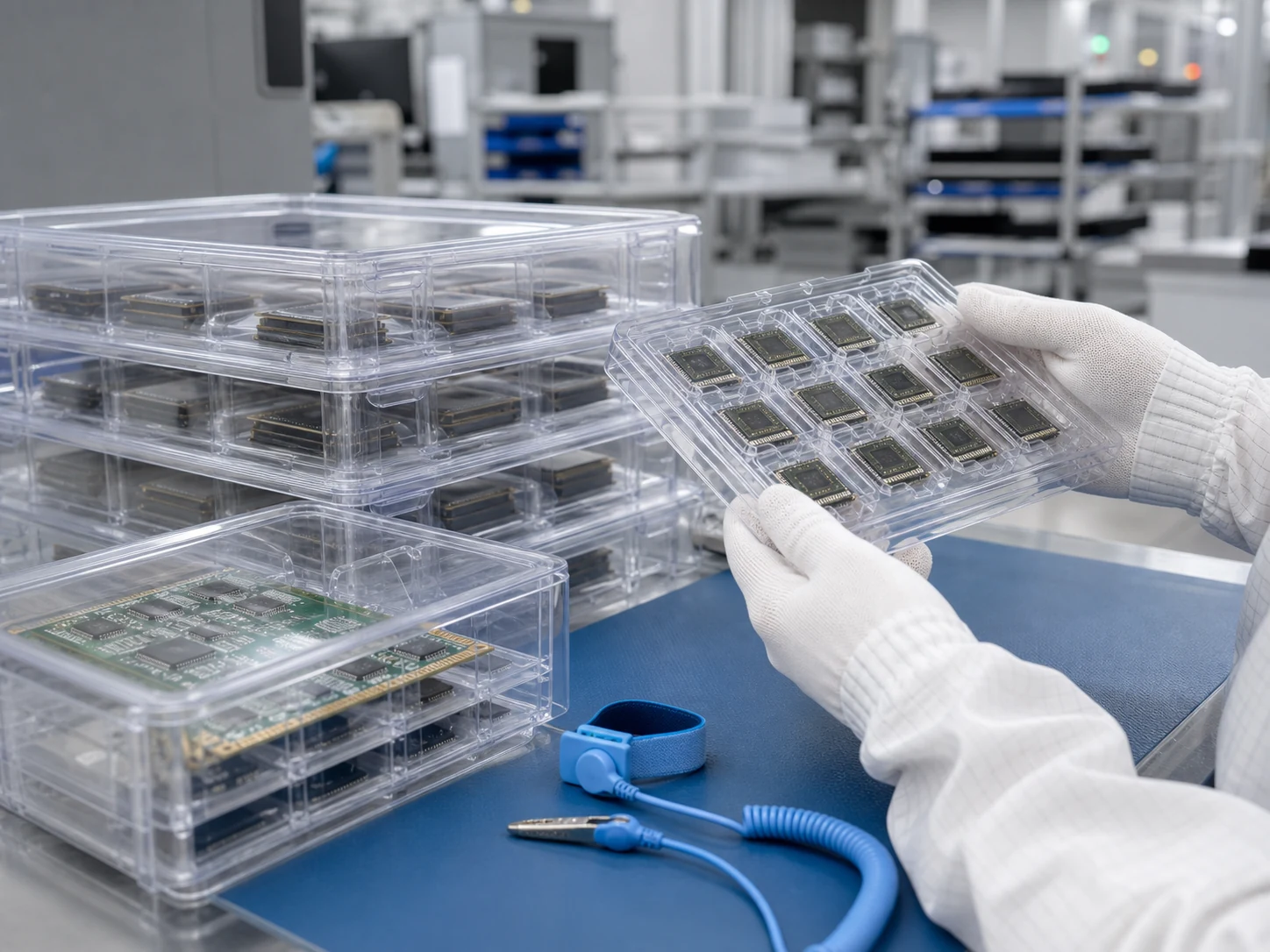
Medical field: a clean and precise protector. Many precision instruments in hospitals, such as monitors, analyzers and surgical equipment, use transparent antistatic plastic for housings and protective covers. There are three reasons: first, transparent design lets doctors and nurses observe equipment status and data at any time; second, antistatic properties help avoid static interference with precision sensors, keeping measurements accurate and reliable; third, when static is reduced, dust and bacteria in the air are less likely to be attracted to equipment surfaces, helping keep medical environments clean.
In this field, the PMMA version of DGK-KJD890TM is often preferred. PMMA, or acrylic, is already known for high clarity and surface hardness. This material reaches a tensile strength of 59.4 MPa, flexural strength of 75.3 MPa and flexural modulus of 1891 MPa. Its stiffness and scratch resistance are better than the ABS version, making it suitable for instrument panels, observation windows and other parts requiring high surface hardness and dimensional stability. Its heat deflection temperature reaches 95℃, which also helps it better withstand high-temperature disinfection environments for medical equipment.
Food and pharmaceutical packaging: a clean and safe outer layer. Have you noticed that some high-end medicine or health-product inner trays look similar to ordinary plastic, yet seem less likely to attract dust? That is probably the contribution of antistatic plastic. Drugs and food have very high cleanliness requirements. Ordinary plastic packaging can easily attract airborne dust, hair and fibers during production and transportation because of static. Once these contaminants enter the package, product safety may be affected. Antistatic plastic can greatly reduce this attraction, making the contents cleaner and safer.
Automotive industry: a good partner for intelligent cabins. As vehicles become more intelligent, central control screens, LCD dashboards and touch panels have become standard. In dry winter, these screens and panels easily accumulate static, affecting appearance and possibly interfering with touch sensitivity. Protective layers and interior parts made from transparent antistatic plastic can effectively reduce this issue. Around battery modules in new energy vehicles, antistatic materials are also used to prevent static accumulation from interfering with the battery management system.
Aerospace and precision manufacturing: a reliable choice in extreme environments. In space exploration, precision instruments are even more sensitive to static. Without atmospheric protection in space, static is more likely to accumulate and harder to release. Transparent antistatic plastic is used in instrument covers, observation windows and other spacecraft parts to help precision equipment operate stably in extreme environments.
6. ABS or PMMA? How to choose and use them
After learning all this, you may ask: the DGK-KJD890TM series has ABS and PMMA versions. Which one should be selected? And how should it be used and maintained in daily applications?
How to choose between the two materials? The table below shows the differences.
| Comparison Dimension | ABS DGK-KJD890TM | PMMA DGK-KJD890TM |
|---|---|---|
| Clarity | Ultra-high clarity | High clarity |
| Antistatic performance | Durable antistatic, surface resistivity 10⁸-10¹⁰ Ω/□ | Durable antistatic, surface resistivity 10⁹-10¹¹ Ω/□ |
| Tensile strength | 39 MPa | 59.4 MPa |
| Flexural strength | 57 MPa | 75.3 MPa |
| Elongation at break | 35.8% | 22% |
| Notched impact strength (Charpy) | 10.5 KJ/m² | 4.0 KJ/m² |
| Heat deflection temperature | 85℃ | 95℃ |
| Density | 1.118 g/cm³ | 1.154 g/cm³ |
| Melt flow rate | 48 g/10min (220℃/10Kg) | 9.3 g/10min (230℃/3.8Kg) |
| Flame-retardancy rating | UL-94 HB | UL-94 HB |
In simple terms: choose the ABS version when good toughness, impact resistance and easy processing are required, such as handling trays, equipment housings and packaging inserts. Choose the PMMA version when high hardness, stiffness, heat resistance and better surface feel are required, such as instrument panels, observation windows, screen protective layers and decorative parts with higher appearance requirements. Both use intrinsic modification to achieve permanent antistatic performance, so there is no need to worry about the effect decaying after long use.
What should be noted during processing? Both materials use injection molding, but the process parameters are slightly different:
ABS version: drying temperature 85℃, drying time 4-5 hours; injection temperature 195-210℃; mold temperature 70℃.
PMMA version: drying temperature 90℃, drying time 4-5 hours; injection temperature 195-215℃; mold temperature 90℃.
Thorough drying is critical. If plastic pellets absorb moisture, bubbles can form inside the molded part during injection, reducing both clarity and mechanical performance.
Use and maintenance recommendations:
Avoid cleaning with strong acids or strong alkalis to prevent surface damage.
Do not wipe with hard tools such as steel wool, which can scratch the surface.
Because this is permanent intrinsic modification, there is no need to worry about water washing or friction eliminating the antistatic effect. This is also its biggest advantage compared with coating-type products.
Avoid long-term exposure to high-temperature environments. The recommended long-term service temperature is no more than 80℃ for the ABS version and no more than 90℃ for the PMMA version.
The future is worth looking forward to. As materials science advances, transparent antistatic plastic is developing toward multifunctionality. Scientists are developing composite materials that combine antistatic, blue-light blocking, anti-glare, self-cleaning and antibacterial functions. Perhaps in the near future, your home windows will automatically resist static and dust, your eyeglass lenses will block blue light and resist static, and your car windshield will stay clear and bright in dry winter.
Next time you notice a transparent panel that stays unusually clean, or a clear protective cover in an electronics factory or hospital that does not collect dust easily, take another look. Transparent antistatic plastic may be doing the work. If you have related material-selection needs, contact Clearastatic for professional material solutions.