
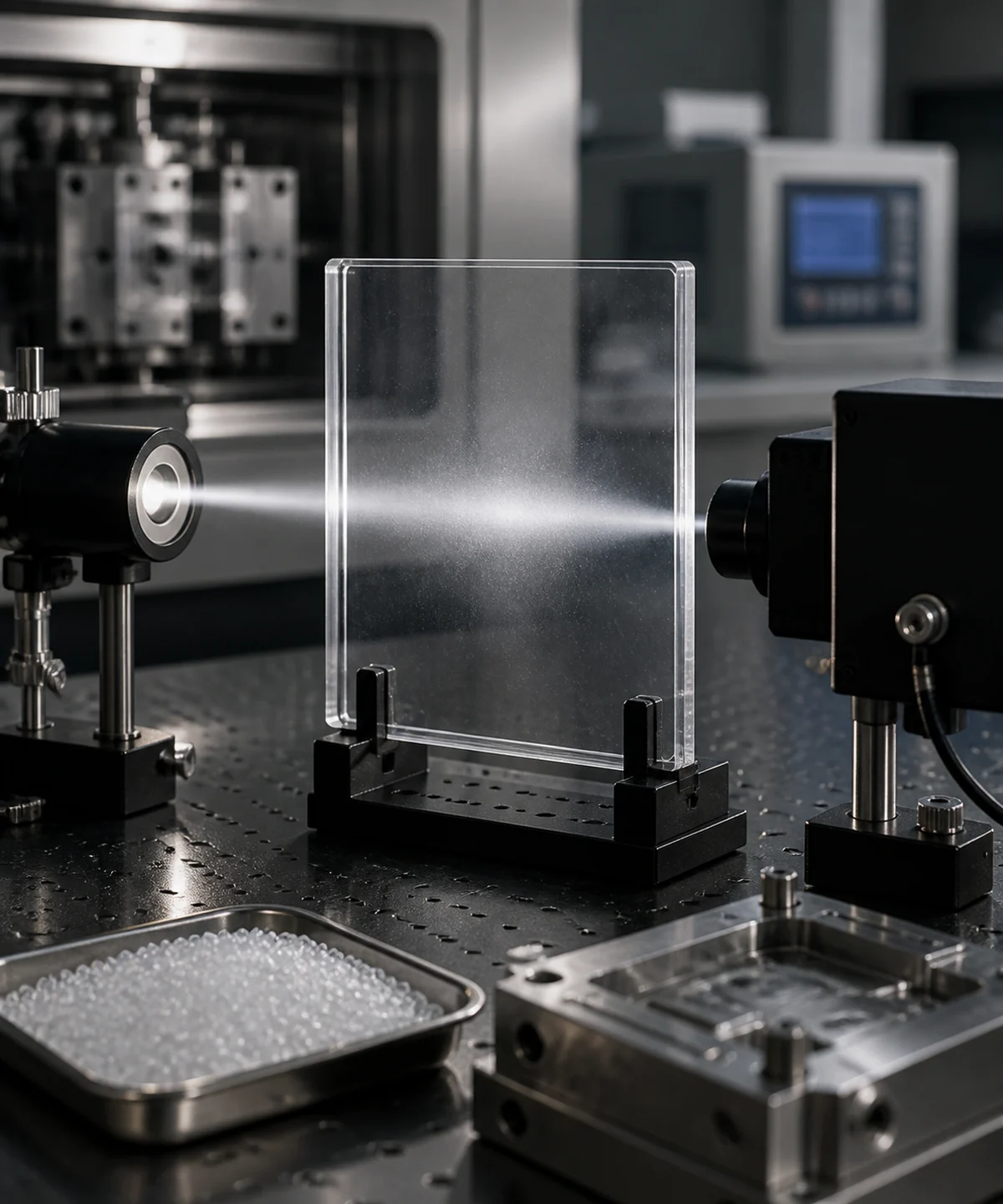
In semiconductor packaging and testing, medical equipment windows and precision electronics packaging, seeing clearly and protecting effectively are long-standing requirements that are difficult to satisfy at the same time. Pure ABS has good light transmission and mechanical performance, but it has no antistatic function. Its volume resistivity can typically reach 10¹⁴-10¹⁶ Ω·cm. After frictional charging, static charge cannot dissipate quickly, which can cause dust adhesion, component breakdown or signal interference. Giving transparent ABS antistatic function involves multiple challenges in materials science and processing.
1. Three technical challenges of transparent antistatic ABS
Challenge 1: the fundamental contradiction between transparency and antistatic performance
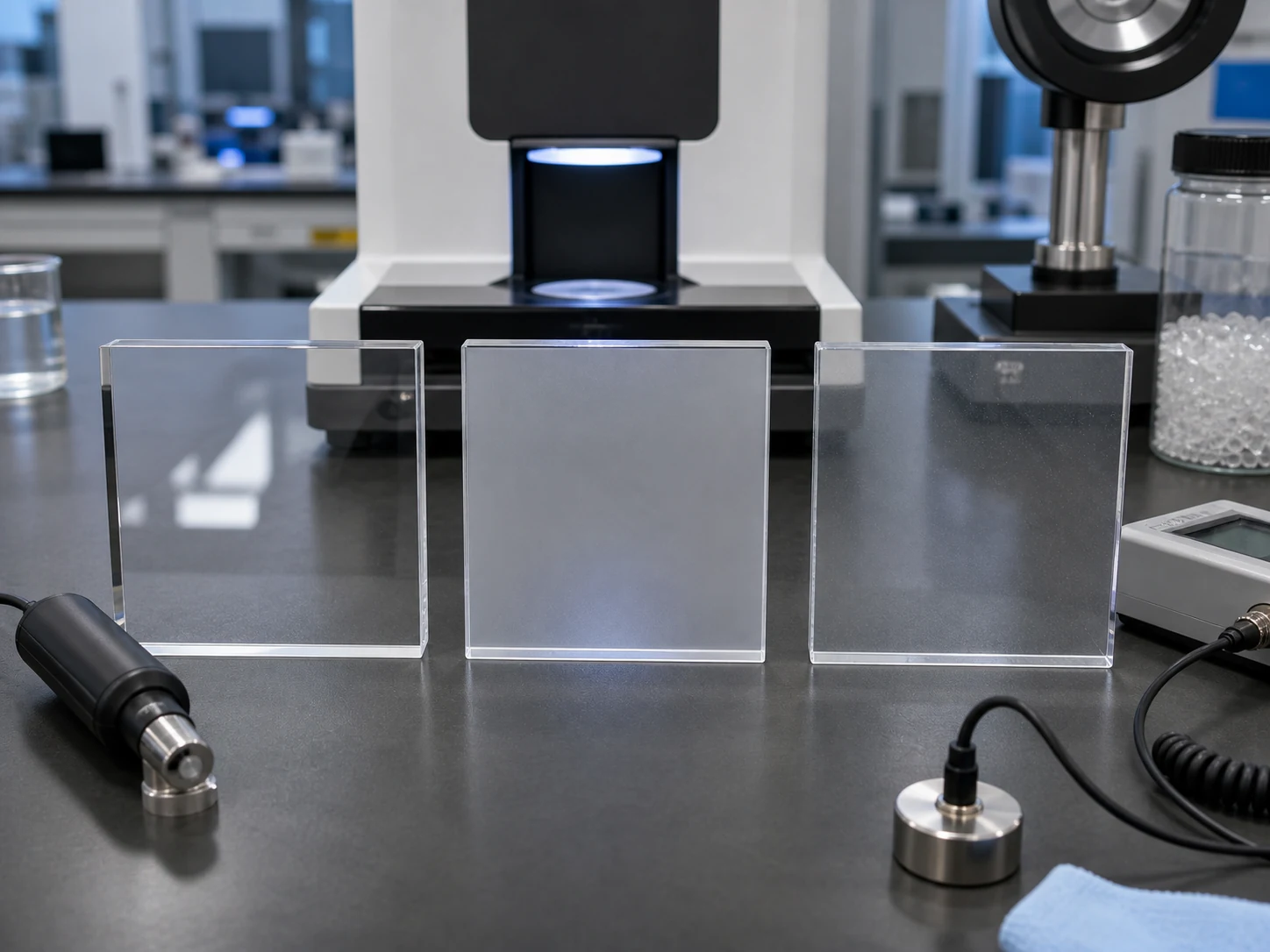
To give plastics antistatic function, the mainstream route is adding conductive fillers or antistatic agents. Conductive carbon black and carbon fiber provide stable antistatic performance and do not depend on environmental humidity, but they turn the material black and opaque. To keep transparency, the carbon black route must be abandoned and antistatic agents must be used instead. Traditional low-molecular antistatic agents have limited compatibility with transparent ABS. If the addition level is slightly high, they bloom out and form white haze or oil marks on the product surface, directly damaging transparency.
Refractive-index matching is even more difficult. The light transmission of transparent ABS depends on how close the refractive indexes of the matrix and additive are. If the antistatic agent has a large refractive-index difference from the ABS substrate, light scatters at the two-phase interface, haze rises and transmission falls. This is the root reason many transparent antistatic materials only achieve 60%-70% actual light transmission.
Challenge 2: how to guarantee permanent antistatic performance
Surface-coated antistatic agents can give transparent parts short-term antistatic performance, but the antistatic layer easily decays because of wiping, washing or humidity changes, so the effective life is limited. In cleanroom environments, trays and panels need frequent alcohol wiping and disinfection. This daily operation is fatal to coating-type solutions; the antistatic layer can be consumed within months.
Migrating antistatic agents also have problems. Antistatic molecules migrate from inside the material to the surface to work, but the migration rate declines over time, and wiping accelerates consumption. Surface resistance is qualified at shipment but fails after six months of use. This is a long-standing hidden problem in the industry.
Challenge 3: the injection-molding process window is extremely narrow
Transparent antistatic ABS is highly sensitive to injection molding. If drying is insufficient, residual moisture creates silver streaks and bubbles on the product surface, directly destroying light transmission. If injection temperature is too high, the antistatic agent may thermally decompose and antistatic performance decays. If temperature is too low, melt flow is insufficient and surface gloss declines. Mold temperature is also critical: when mold temperature is too low, the antistatic dispersed phase is frozen in an oriented state and haze spots appear. Small fluctuations in injection speed, back pressure and holding time may also affect the distribution uniformity of the antistatic agent across the product, causing local resistance to exceed the target range.
2. How the technical route is selected
| Technical Route | Transparency | Antistatic Durability | Humidity Dependence | Typical Surface Resistance |
|---|---|---|---|---|
| Conductive filler filling (carbon black/carbon fiber) | Opaque (black) | Permanent | None | 10³-10⁶ Ω |
| Surface-coated antistatic agent | High initially | Poor, decays in months | Yes | 10⁶-10⁹ Ω |
| Migrating antistatic agent | Relatively high | Medium, gradually decays | Strong | 10⁹-10¹¹ Ω |
| Polymeric permanent antistatic agent | ≥85% | Permanent | Weak | 10⁸-10¹⁰ Ω |
The table shows that polymeric permanent antistatic agent technology is the only route that can satisfy high light transmission and permanent antistatic performance at the same time.
3. Clearastatic solution: DGK-ABS KJD890TM
Clearastatic DGK-ABS KJD890TM uses the route of melt-blending polymeric permanent antistatic agent with a transparent ABS substrate.
The core logic is this: the antistatic agent does not rely on low-molecular migration to the surface. Instead, it is blended with ABS in polymer form and forms a sub-microscopic conductive network inside the substrate. This network provides a stable static dissipation path while keeping visible-light scattering low. Because the antistatic component is anchored inside the substrate, it does not migrate or bloom, and surface resistivity does not change significantly after repeated water washing or long-term storage.
Key performance indicators:
| Property | Test Standard | Typical Value |
|---|---|---|
| Light transmission (2 mm) | ASTM D1003 | ≥87% |
| Haze (2 mm) | ASTM D1003 | <8% |
| Surface resistivity | ASTM D257 | 2×10⁸-8×10⁸ Ω/□ |
| Tensile strength | GB/T 1040-2006 | 39 MPa |
| Flexural strength | GB/T 9341-2008 | 57 MPa |
| Izod notched impact strength | GB/T 1843-2008 | 12.3 kJ/m² |
| Melt flow rate (220°C/10kg) | GB/T 3682-2000 | 48 g/10min |
| Heat deflection temperature (0.45MPa) | GB/T 1633-2000 | 85°C |
In the transparent antistatic ABS category, 87% light transmission is a high level. The melt flow rate of 48 g/10min gives strong flowability, smooth filling and a shorter injection-molding cycle.
Key validation data:
- After 500 alcohol wipes, surface resistivity changes by less than one order of magnitude and remains within 10⁸-10⁹ Ω/□.
- At 15% RH low humidity, surface resistivity changes by less than twofold, indicating weak dependence on environmental humidity.
- After 24 hours in 60°C water, surface resistivity increases by less than 30%.
4. Target applications
DGK-ABS KJD890TM covers multiple stages of semiconductor and electronics manufacturing:
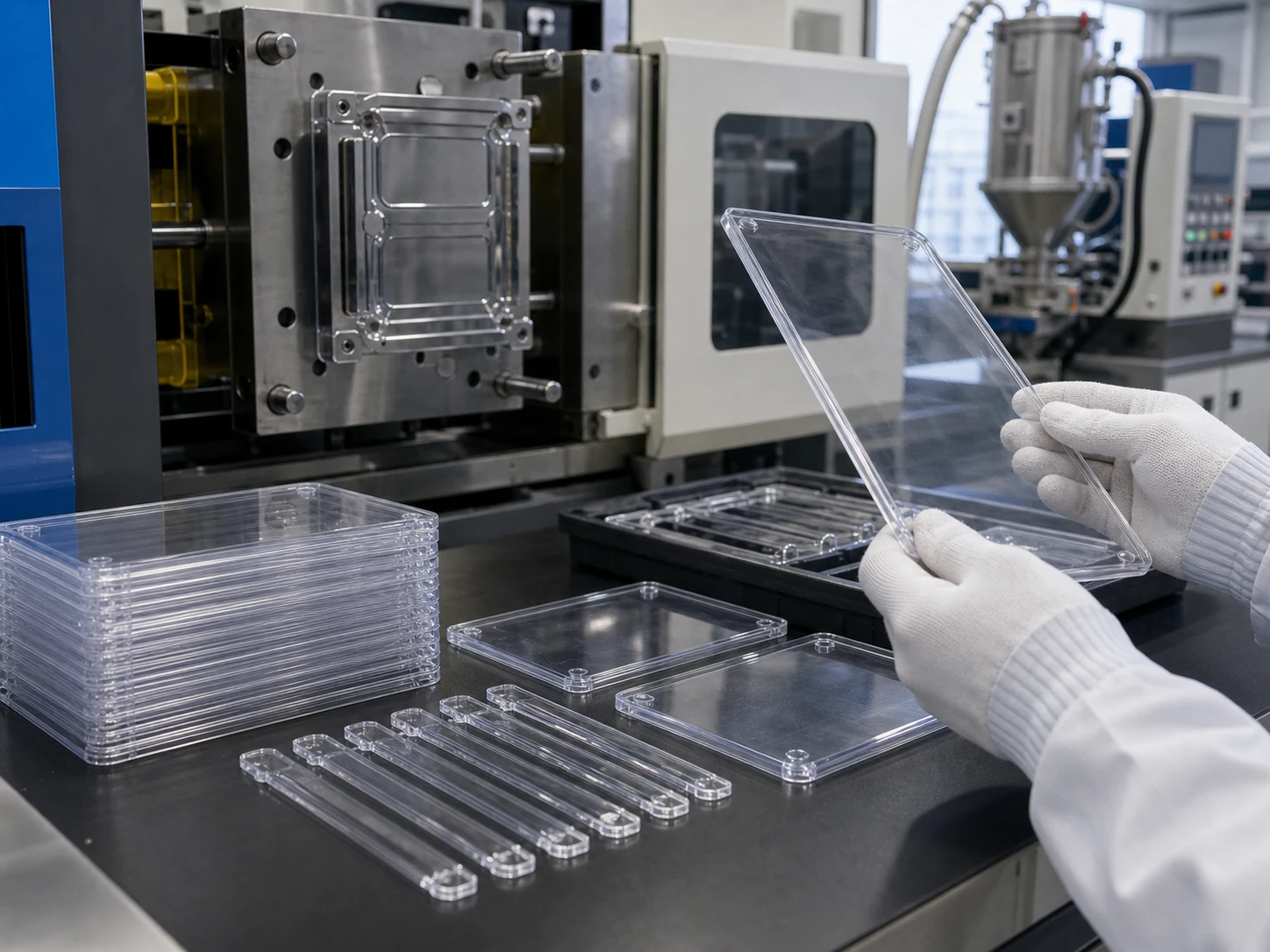
Semiconductor and electronics manufacturing: wafer transfer windows, antistatic handling boxes, display cover plates and chip antistatic packaging boxes. Operators can confirm internal material status without opening the package, and vision systems can identify directly through the packaging.
Medical equipment: monitor display covers, incubator observation windows and biosafety cabinet windows. It meets the durability requirement of frequent alcohol wiping for medical equipment.
Cleanrooms and laboratories: cleanroom equipment housings, test tube racks that need to avoid static dust adhesion, and industrial instrument panels.
Consumer electronics and appliances: transparent housings, high-end toys/models and control panels.
5. Customer case: full validation process for a medical monitor panel
Background and initial solution
A domestic medical device brand required its monitor front panel to satisfy two requirements: transparency for medical staff to read screen information and antistatic performance to prevent dust from affecting clarity. The customer originally used an ordinary transparent ABS cover plate sprayed with an antistatic surface agent.
Difficulties encountered
Surface resistance and light transmission met requirements at shipment, but in ICU environments the panel had to be wiped and disinfected several times every day with 75% alcohol. After 3 to 6 months of use, the antistatic coating was consumed and resistance failed. Screen dust attraction caused by static then appeared intensively and affected readings.
The customer tried adjusting the spraying process and replacing different antistatic agents, but none solved the half-year failure pain point. The decay of a surface-coated solution is a structural material problem, not a process problem.
Solution switch and debugging process
The customer switched to DGK-ABS KJD890TM. The Clearastatic technical team helped complete the full validation test:
First round: mold trial according to recommended process. Drying temperature 85°C, drying time 4-5 hours, injection temperature 195-210°C and mold temperature 70°C. Light transmission reached 87%, and measured surface resistivity was 3.2×10⁸ Ω/□. Both met the targets, but slight haze spots appeared in thin-wall areas of about 1.2 mm.
Second round: root-cause analysis of haze spots. Clearastatic engineers checked on site and found that haze spots were concentrated in thin-wall areas and at melt-flow ends. The analysis was that the melt moved quickly in thin walls, shear was strong, the antistatic dispersed phase oriented under high-speed shear, particle size increased and Rayleigh scattering became stronger. The adjustment was to raise mold temperature from 70°C to 75°C and change injection speed to staged injection (slow-medium-slow).
Third round: validation and locking. After adjustment, haze spots disappeared completely and light transmission stayed above 87%. Surface resistivity variation across different product positions was controlled within 0.5 order of magnitude, meeting the customer's requirement that resistance variation within the same part not exceed one order of magnitude.
Final results:
| Comparison Dimension | Original Coating Solution | DGK-ABS KJD890TM |
|---|---|---|
| Light transmission | ~87% | ≥87% |
| Initial surface resistivity | Qualified | 2×10⁸-8×10⁸ Ω/□ |
| Surface resistivity after 500 alcohol wipes | Failed | Still 10⁸-10⁹ Ω/□ |
| Resistance change at 15% RH | Large increase | <2 times |
| Validated stability | Decay commonly appeared after 3-6 months | Remained within the project range in completed wiping, low-humidity and water-treatment tests |
| Cumulative delivery | - | About 150,000 parts (Clearastatic project records) |
| After-sales record | Static-related dust complaints occurred | No static-related dust complaint in the recorded period |
The material has achieved batch commercial use in medical monitor panels and is also used in semiconductor cleanroom observation windows, optical inspection equipment panels, drone ground-station display covers and other scenarios.
6. Small-batch validation and batch consistency
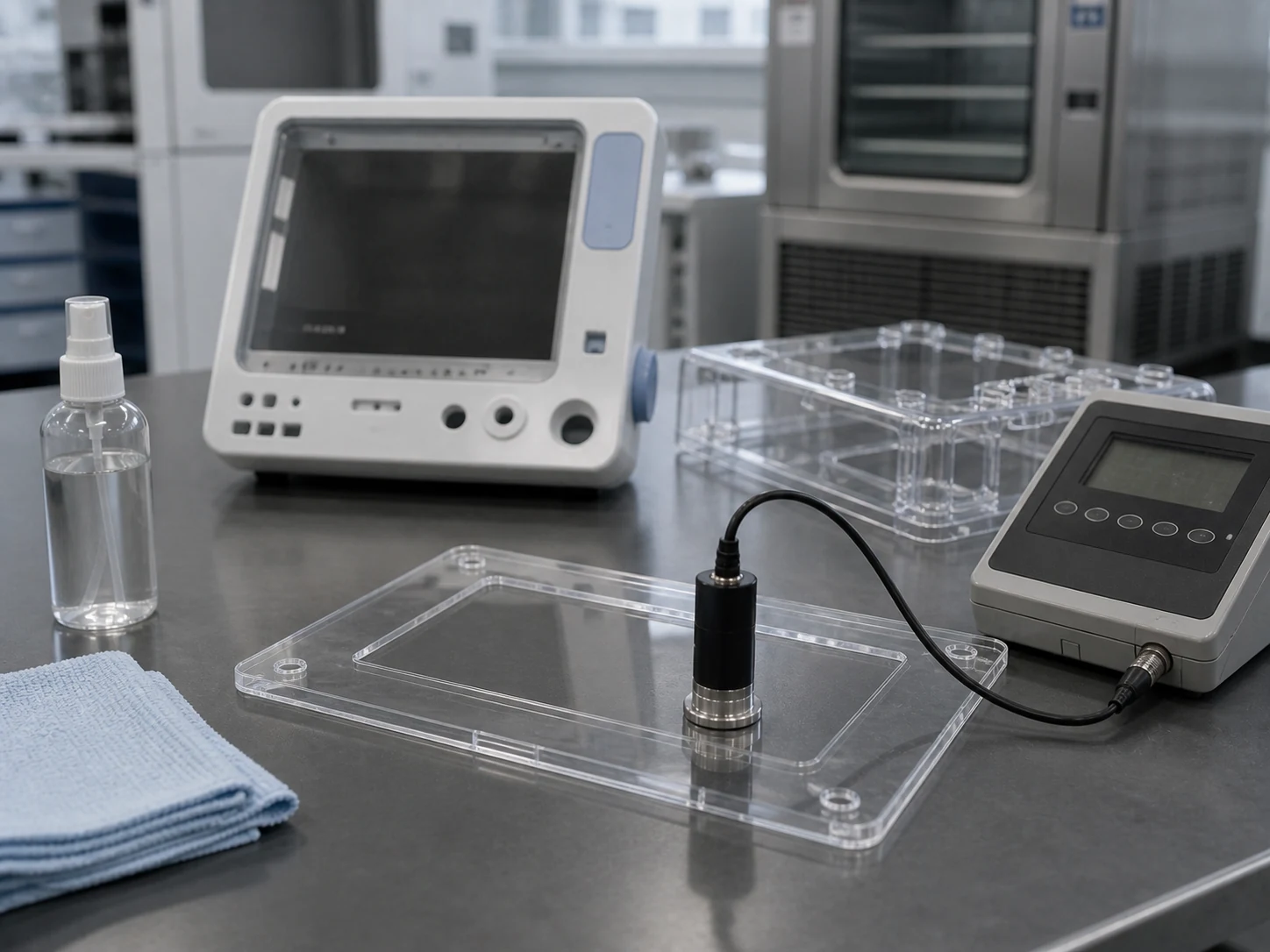
Clearastatic provides small-batch validation service starting from 5 kg, with sample delivery in 72 hours. The company has 8 production lines, monthly capacity of 800 tons and batch resistivity Cpk ≥ 1.33. Each batch comes with a national-standard physical property test report. Batch light transmission and antistatic performance remain uniform and stable, with injection-molding process window cards and mold design recommendations provided.
7. Summary
The technical challenges of transparent antistatic ABS concentrate on three levels: how to achieve antistatic function while maintaining high light transmission, how to make the antistatic effect permanent without decay, and how to obtain stable product quality within a narrow injection-molding process window.
DGK-ABS KJD890TM uses polymeric permanent antistatic agent technology and provides verifiable data including light transmission ≥87%, surface resistivity 2×10⁸-8×10⁸ Ω/□, and surface-resistivity change of less than one order of magnitude after 500 alcohol wipes. The material has reached batch use in medical monitor panels, semiconductor cleanroom observation windows and optical inspection equipment panels. Delivery and after-sales figures are based on Clearastatic project records; the customer name is withheld for confidentiality.
Technical documents and sample information can be obtained through Clearastatic official channels.