
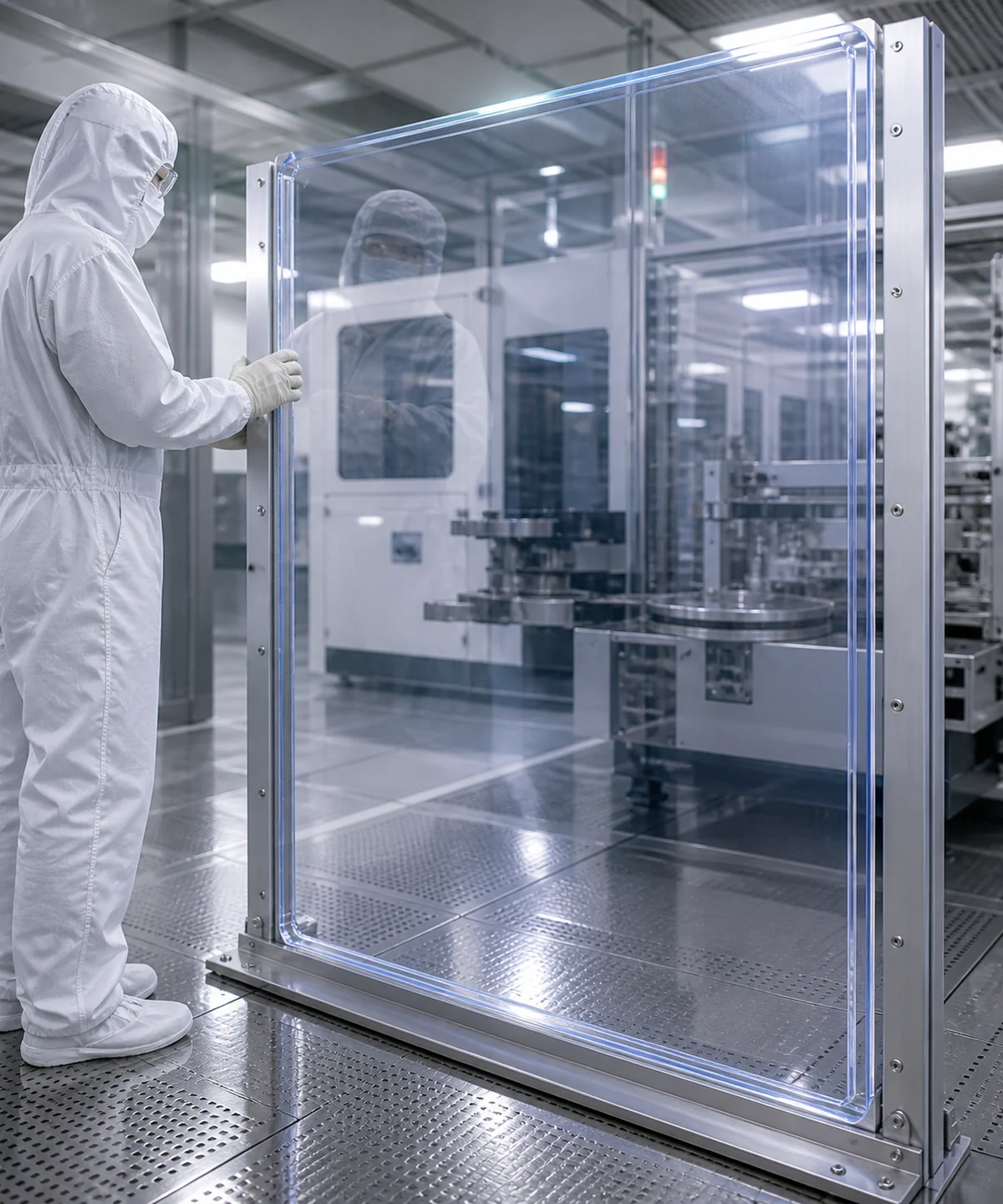
In semiconductor equipment observation windows, cleanroom protective guards and medical equipment clear housings, transparent antistatic plastic is almost unavoidable. The requirement is clear: the material must be transparent for observation, antistatic to prevent dust adsorption or electrostatic breakdown, and often large enough to require real strength.
But once material selection begins, engineers find that the options are far fewer than expected. Small transparent parts can use ABS or PMMA. Once the part size increases and impact resistance becomes a requirement, the choice narrows to PC, and transparent antistatic PC available in the market is almost entirely based on surface coating.
Why does this happen?
1. Small-size choices: ABS and PMMA each have strengths
For small transparent antistatic parts, such as IC trays, wafer transfer windows and display cover plates, material selection is relatively mature.
Transparent ABS is one of the most common choices in antistatic applications. Taking Clearastatic DGK-ABS KJD890TM as an example, this material uses a polymeric permanent antistatic route. At 2 mm thickness, light transmission can reach 87%, and surface resistivity is stable at 2×10⁸-8×10⁸ Ω/□. It has balanced mechanical performance, good processing flowability and is suitable for injection molding complex structures. Its Izod notched impact strength is about 12.3 kJ/m², and elongation at break is about 35.8%, making it a relatively tough option among transparent antistatic materials.
Transparent ABS also has an engineering risk that must be controlled: moisture sensitivity. Transparent ABS has a water absorption rate of about 0.6%. If drying before injection molding is insufficient, the molded part can show silver streaks or haze spots. Even if molding is initially qualified, long-term high-humidity use or water washing may cause fogging. Although it can recover after drying, this remains a process-control risk for applications that must maintain high transparency over long periods.
Transparent PMMA has the best optical performance, with light transmission above 90%. It has high surface hardness and excellent scratch resistance. Clearastatic DGK-PMMA KJD890TM uses polymeric permanent antistatic modification, with surface resistivity matching the site material-table range of 10⁹-10¹¹ Ω/□. However, PMMA has weaker impact resistance than ABS and PC. The site table lists Charpy notched impact strength at 4.0 kJ/m² and Izod notched impact strength at 5.3 kJ/m². Large PMMA parts can crack under stress, so PMMA is more suitable for small, non-load-bearing scenarios with very high optical requirements.
These two materials each have application space in small, non-load-bearing or lightly loaded parts, and both mature intrinsic antistatic routes are available. Polymeric permanent antistatic agents are distributed inside the material, do not migrate or bloom, and after repeated wiping or long-term storage, surface resistivity does not change significantly.
2. The large-size problem: only PC can meet impact requirements
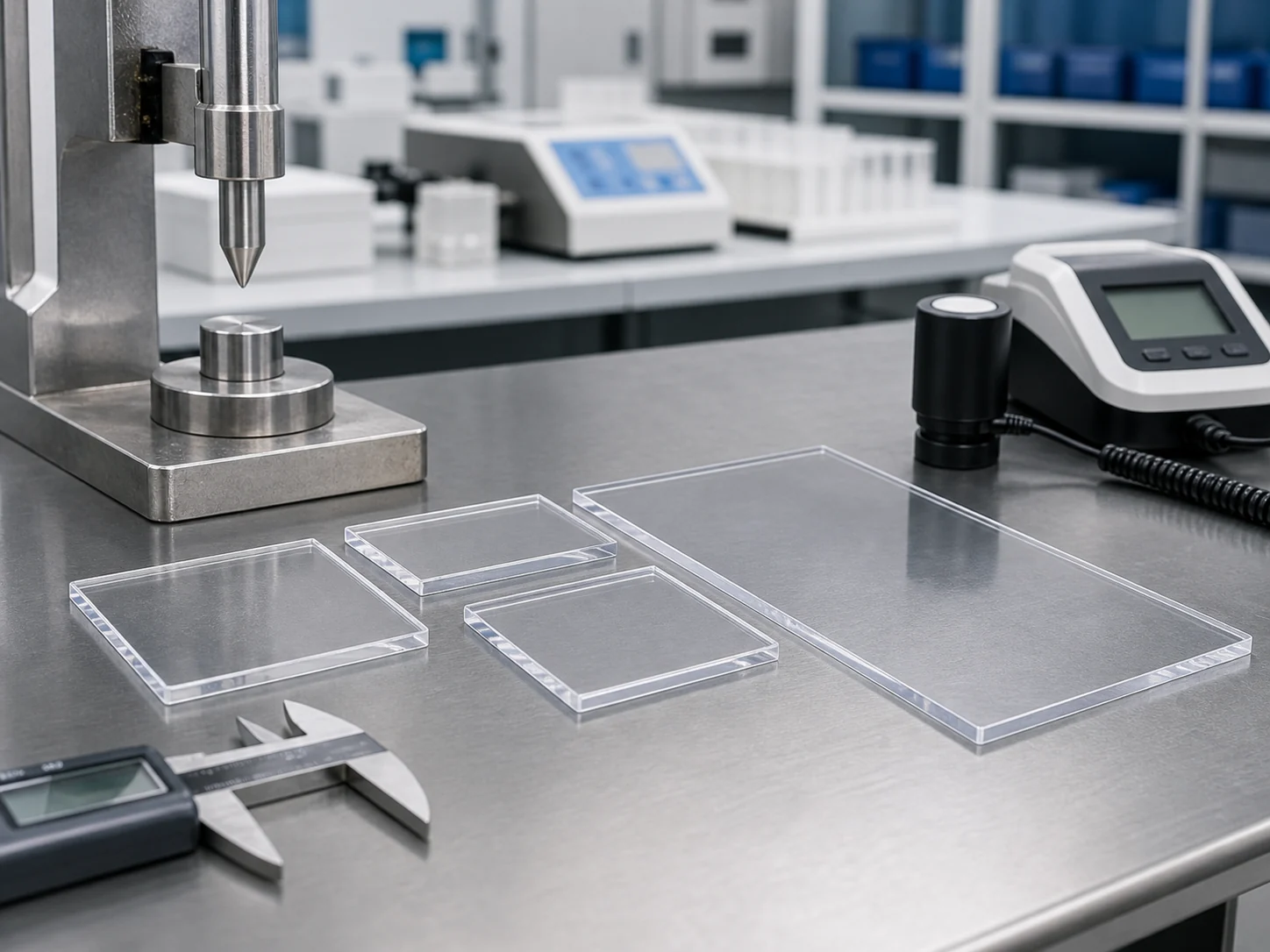
When part size increases and impact resistance becomes a rigid requirement, such as semiconductor equipment observation windows, cleanroom guards and explosion-proof equipment windows, ABS and PMMA often cannot carry the load.
PC has a very clear impact-strength advantage. Polycarbonate sheet is far stronger in impact resistance than ordinary glass, tempered glass and acrylic. For large transparent parts that need to withstand mechanical impact, thermal expansion and contraction or repeated operation, PC is almost the only reasonable choice.
The problem is that transparent antistatic PC on the market is almost entirely based on surface coating.
3. Surface coating limits: once the coating wears, antistatic performance stops
Surface coating means spraying or coating an antistatic layer on the surface of a PC sheet or finished part. Common antistatic PC sheets on the market are usually surface-antistatic products, where ordinary PC sheet gains antistatic function through film deposition or antistatic coating.
The initial result can be good: light transmission can reach above 85%, and antistatic performance can meet the target. The problem is durability.
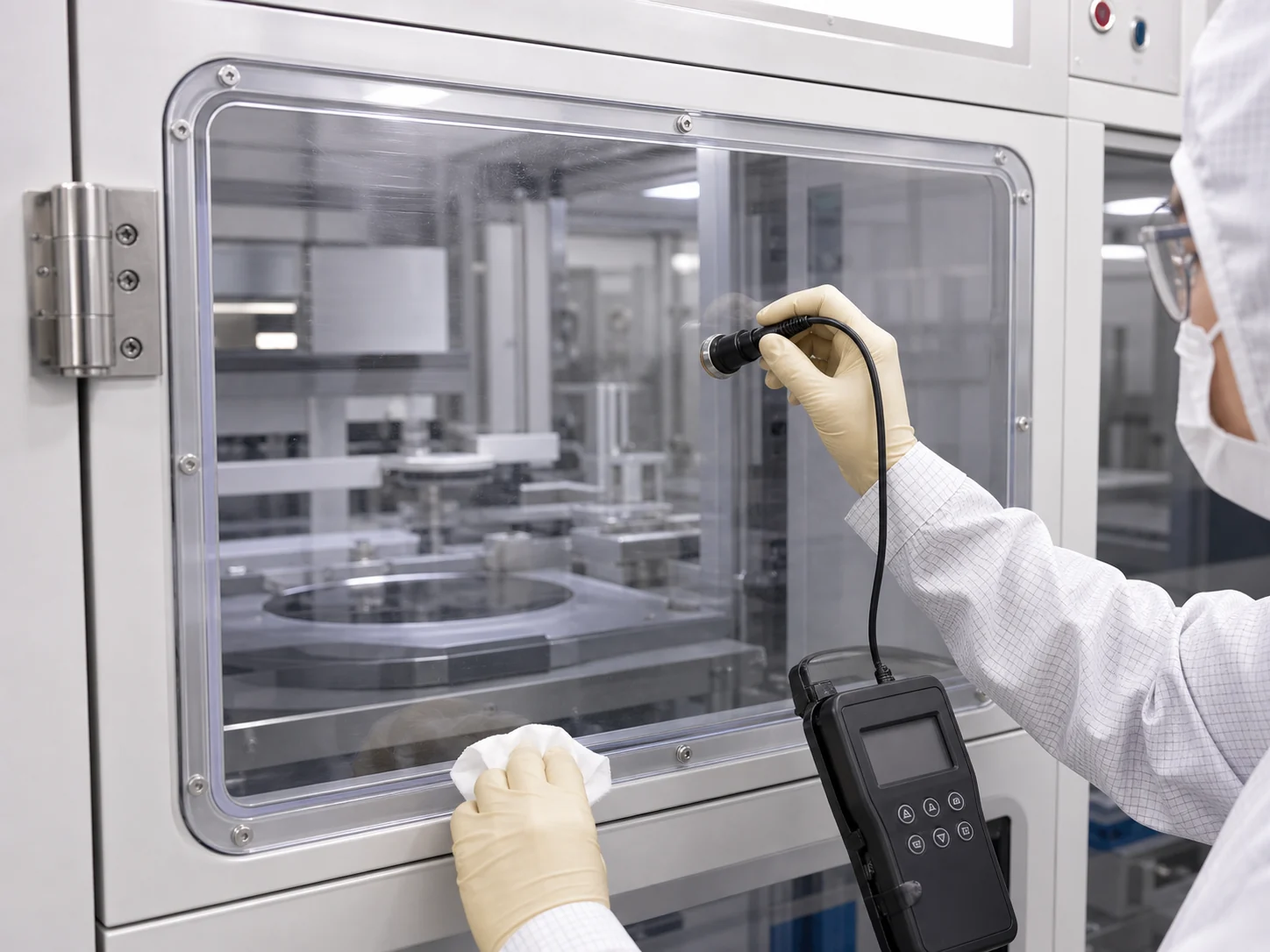
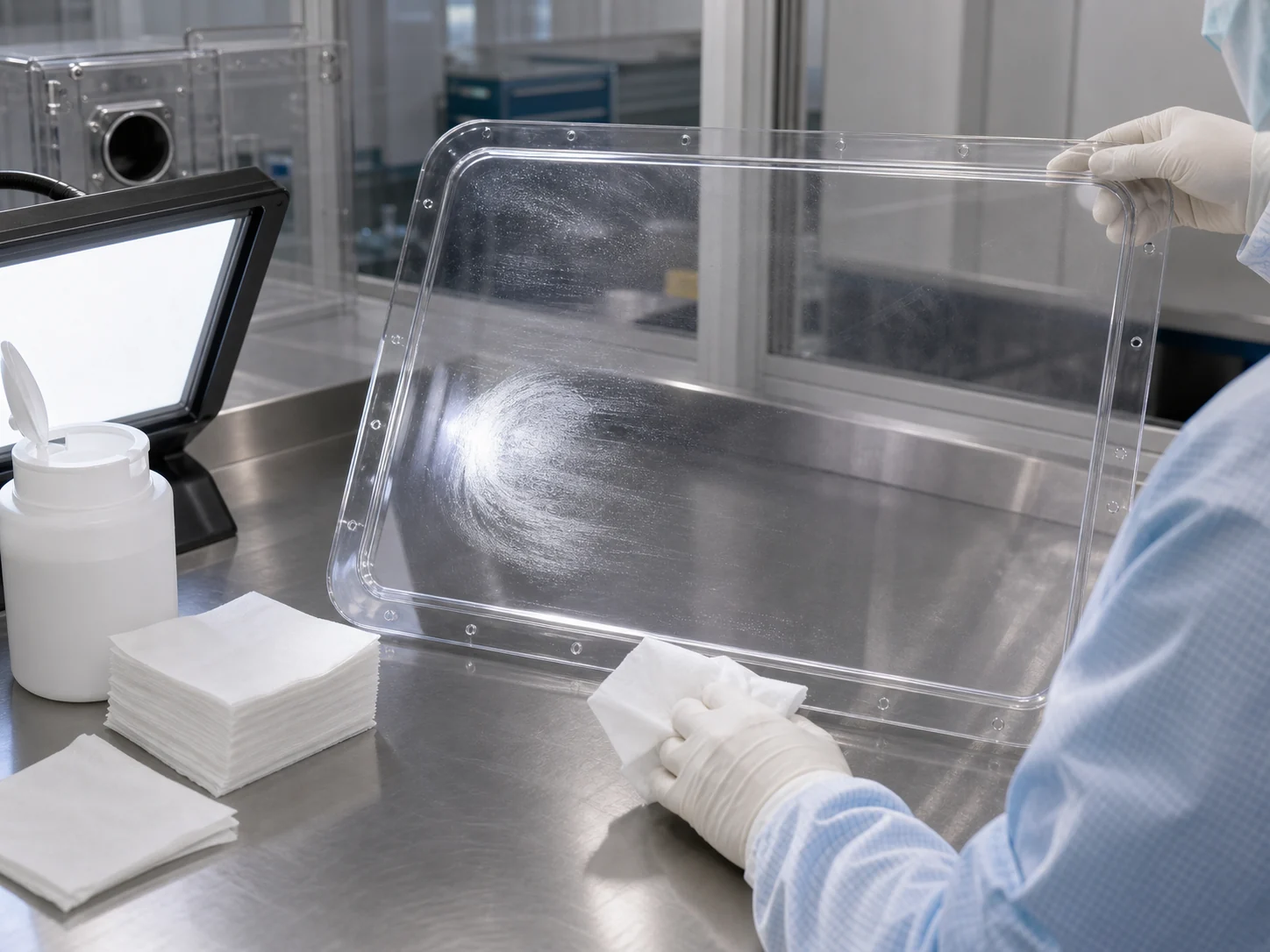
The antistatic coating is attached to the PC surface. After repeated wiping, cleaning or mechanical contact, the coating gradually wears or is scratched away. Once the coating is damaged, antistatic performance in that area is completely lost and cannot self-recover. For cleanroom equipment observation windows and medical equipment housings that require frequent cleaning, this means regular recoating and planned maintenance.
This is the fundamental difference between surface treatment and intrinsic modification: the former works only on the surface, while the latter solves the problem from inside the material.
4. Why not make transparent intrinsic antistatic PC?
This leads to the key question: since ABS and PMMA can both be made intrinsic antistatic, why not PC?
The real industry situation is that transparent intrinsic antistatic PC with mature industrial stability is still not available as a general solution.
PC has a special material system. ABS and PMMA tolerate additives more easily, so they can achieve intrinsic antistatic performance through polymeric permanent antistatic agents while maintaining acceptable transparency and mechanical performance. PC is different. The introduction of a third component can significantly affect molecular-chain regularity and impact performance. Achieving polymeric permanent antistatic performance in PC while maintaining high light transmission places extremely high requirements on compatibility with the PC substrate, refractive-index matching and dispersed particle-size control. The industry has not fully solved this contradiction.
Clearastatic has already laid out work in transparent antistatic PC. Its transparent antistatic PC series is positioned around 85%-90% light transmission and 10⁸-10¹⁰ Ω surface resistance, with project-specific optical results depending on thickness and coating route. But this product category still faces the inherent challenge of the PC system: how to retain PC's high impact resistance while achieving intrinsic antistatic behavior under transparent conditions. At present, there is no perfect industry solution.
Clearastatic's advantage is that it is a professional modification company covering multiple base resins in conductive and antistatic materials. Its material routes cover ABS, PP, PE, PC, PA, POM, PBT and mainstream plastics, as well as high-end engineering plastics such as PPS, PEI and PEEK. When customers encounter bottlenecks on large transparent antistatic PC, Clearastatic can provide alternative paths, such as switching to intrinsic antistatic ABS or PMMA where design allows, or providing coated PC process guidance and technical support to improve stability under the existing route.
5. Real customer case: material selection for a large transparent antistatic observation window
A semiconductor equipment manufacturer in East China needed customized transparent observation windows for wafer transfer equipment. The part size was 600 mm × 400 mm × 4 mm. Requirements included light transmission ≥85%, surface resistivity 10⁶-10⁹ Ω/□, mild mechanical collision resistance during operation and regular alcohol wiping.
First attempt: transparent antistatic PMMA. The customer used Clearastatic DGK-PMMA KJD890TM. Light transmission met the target, but in simulated impact testing, the 4 mm PMMA observation window showed cracks under low-energy impact. PMMA impact resistance could not meet the use requirements of the equipment.
Second attempt: transparent antistatic ABS. The customer tried Clearastatic DGK-ABS KJD890TM. Light transmission was about 87%, surface resistivity was 2.5×10⁸ Ω/□, and the main indicators were qualified. But at the large size of 600 mm × 400 mm, the ABS sheet showed obvious sagging under its own weight, and dimensional stability after forming was insufficient for the equipment installation precision.
Third attempt: surface-coated antistatic PC. The customer selected a commercial surface-coated antistatic PC sheet. Light transmission was 87%, surface resistivity was 5×10⁷ Ω/□, and impact performance met the requirement. But after three months of actual operation, operators reported local static-control failure on the observation window. Testing showed that frequently wiped areas had surface resistance above 10¹¹ Ω, outside the project requirement. The reason was that the antistatic coating gradually wore during repeated wiping, while the PC sheet body did not have antistatic performance.
Final route: the customer is still looking for a transparent intrinsic antistatic PC solution. Clearastatic already has mature intrinsic antistatic products in transparent ABS and PMMA, but in large transparent antistatic PC, the industry bottleneck is difficult to break through in the short term. At this stage, the customer can only accept surface-coated PC and define stricter maintenance: recoating the antistatic layer every quarter, with 24 hours of equipment downtime after each recoating to allow coating curing.
6. Practical alternative routes today
If transparent intrinsic antistatic PC cannot yet provide a mature route, are there other choices for large transparent antistatic parts?
Route 1: accept the maintenance cost of coated PC. If impact resistance is a rigid requirement and PC must be used, the project can only accept surface coating and reserve budget and procedures for regular maintenance during the design stage. Clearastatic has accumulated experience in PC modification and can provide coated PC process guidance and technical support.
Route 2: avoid PC through design. If the part does not directly bear mechanical impact, or if thicker walls, protective frames or structural support can compensate for the impact weakness of ABS or PMMA, switching to intrinsic antistatic ABS or PMMA is a more reliable choice. Clearastatic DGK-ABS KJD890TM and DGK-PMMA KJD890TM both use polymeric permanent antistatic technology. Their antistatic performance is permanent and does not depend on a surface coating.
Route 3: explore PC/ABS alloy. PC/ABS alloy has impact performance between pure PC and ABS, and may tolerate intrinsic antistatic modification better. Clearastatic has product layout in PC/ABS alloy antistatic routes, such as the PC/ABS alloy antistatic KJD910 series. This direction is worth attention.
7. Summary
The material-selection difficulty of large transparent antistatic PC is essentially an impossible triangle: high light transmission, high impact resistance and intrinsic antistatic performance. In practice, no mature route can fully satisfy all three at the same time.
| Material | Light Transmission | Impact Resistance | Intrinsic Static Control | Large-Size Suitability | Clearastatic Grade |
|---|---|---|---|---|---|
| ABS | ≥85% | Medium (Izod 12.3 kJ/m²) | Mature | Usable for small to medium sizes | DGK-ABS KJD890TM |
| PMMA | ≥90% | Low (Charpy 4.0 kJ/m², Izod 5.3 kJ/m²) | Mature | Not recommended for large impact-loaded parts | DGK-PMMA KJD890TM |
| PC (coated) | 85-90% | High | No | Usable, but requires regular maintenance | Transparent antistatic PC series |
| PC (bulk) | 85-90% | High | No mature route | No mature general solution | - |
For applications requiring large size, high transparency and impact resistance, PC is the only material that can meet the impact requirement. But transparent antistatic PC currently relies on surface coating as the practical route. Bulk transparent antistatic PC is still an unsolved industry problem.
This reality is unlikely to change quickly. During material selection, the practical work is to clarify early whether the project accepts the maintenance cost of coated PC, or redesigns around ABS or PMMA to use intrinsic antistatic materials. Clearastatic can provide corresponding material solutions and technical support for both paths.